
Recently, for some time now, we have been witnessing unnecessary debates being raised around the medium of education. We are seeing suggestions that the English education system in India is a symbol of Macaulay’s slavery and that we must come out of this so-called bondage. How should this be understood? Should this be seen as opposition to Macaulay and the British? Or should it be understood as intolerance toward the empowerment of marginalized and weaker sections through learning of the English language? Or should it be seen as part of a conspiracy to forcibly impose Sanskrit and derive dual benefits from it? In whichever way one interprets it, approaching it from any perspective, it is condemnable and unacceptable.
Recently, while delivering the Ramnath Goenka Memorial Lecture, Prime Minister Modi mentioned that the Indian education system was dismantled by the Macaulay conspiracy of 1835 and that it promoted a sense of inferiority toward indigenous knowledge. By 2035, it will be 200 years since “Macaulay’s Minute.” The Macaulay Minute (Minute on Indian Education) was essentially a draft of an education policy for India, written by Thomas Babington Macaulay in 1835 during British rule, tailored to British needs. The Prime Minister called upon us to free ourselves from this English-language slavery mindset by 2035. His speech essentially conveyed that after 200 years, India’s servitude to the British must come to an end.
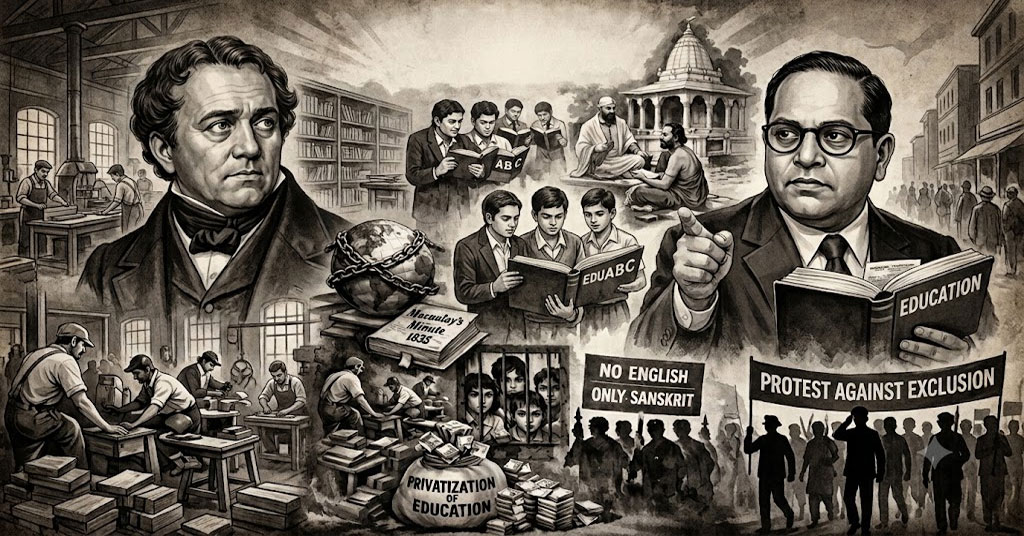
What does the Macaulay Minute contain?
It advocates education through the medium of English and claims that Western education has greater philosophical depth, scientific rigor, and literary development than traditional Indian education systems. Macaulay also stated that spending resources on Sanskrit and Arabic was a waste. Whatever his motives may have been, some limited higher ambition can be seen in Macaulay’s policy.
For whom was this proposal made?
“Indian in blood and colour, but English in tastes, opinions, morals and intellect.” This was its essence—to create a class of people who were Indian by birth but English in outlook. That was Macaulay’s desire and self-interest. At that time, the British needed clerks to run administrative functions. They required intermediaries between the British rulers and the local population. To overcome these challenges, teaching English to the local people became inevitable. This policy turned out to be both a boon and a curse for India. It created opportunities for learning modern education and enabled lower- and middle-class people to study, producing world intellectuals like Dr. B. R. Ambedkar. But for whom did it become a curse? For those who upheld Sanskrit, taught exclusively in elite circles under the banner of Sanatana ideology, as it was pushed to the margins. Education, which had previously been accessible only to a few, became available to all—and that was unacceptable to them. Hence, efforts to overturn the Macaulay model began long ago. Let us assume, for a moment, that their intentions were good.
While introducing the new education policy, the Prime Minister launched a national program called “Pariksha Pe Charcha” in 2018. Its purpose was to reduce exam stress and motivate students. Over ₹70 crore was spent on it. In 2023 alone, the expenditure crossed ₹27.70 crore, followed by ₹16.83 crore in 2024 and ₹18.82 crore in 2025. How should we view this wastage of such enormous funds while citing a lack of resources and handing education over to private players? What ultimately changed after spending such huge amounts? Nothing changed. On the contrary, mandatory scholarship funds for students were cut and diverted toward this unnecessary national program, exposing the hidden agenda behind it.
The Prime Minister stated that the National Education Policy (NEP) 2020 aims to eliminate the Macaulay mindset and that the new education policy would discuss and resolve these issues. However, the loopholes in NEP are many and serious. This new education policy includes several hidden mechanisms that push education away from poor, marginalized, and weaker sections. A dangerous agenda has been designed to divert those deemed “not interested in studies” toward vocational education such as polytechnics, amounting to unconstitutional actions.
Dr. Ambedkar recognized the need for higher education for all and envisioned a society of highly educated people. He championed the slogan that English language and English-medium education are the primary tools for empowering SEBCs and for liberation from mental slavery. However, there is a vast difference between Macaulay’s necessity and Dr. Ambedkar’s far-sighted vision.
In Dr. Ambedkar’s view, English language and English-medium instruction were historical necessities. For oppressed SEBC communities, English represented social mobility—the process by which an individual or family improves its social status. English education also forms the foundation for intellectual liberation and freedom of knowledge. It distances the mind from ignorance, blind beliefs, superstitions, and imposed ideologies, and helps develop the capacity for independent thinking. It provides the courage to strongly resist caste-based oppression and cultivates a scientific temperament that evaluates causes and effects rationally. It is the only emancipatory tool that offers a global and modern outlook.
Moreover, in Dr. Ambedkar’s view, Sanskrit symbolized the dominance of Brahmanical ideology. While primary education in English medium may not be accessible to all, he believed that higher education must certainly be imparted in English. This would contribute to deep intellectual enrichment, provide moral strength to oppressed castes to fight for their rights, and help build an egalitarian society. In Dr. Ambedkar’s words, “English is the milk of the lioness; only those who drink it can roar.” To demonstrate how this is possible, Dr. Ambedkar cited his own life as an example. He studied at the world’s best universities against all odds, established and ran educational institutions with English instruction as their primary mission, and emphasized curriculum priorities—focusing on what subjects are given importance, and what skills, values, and knowledge are taught.
Today, contrary to all this, we must note the attempts to completely abandon English-medium education under the pretext of Macaulay’s self-serving propaganda. At the same time, there are parallel efforts to forcibly impose Sanskrit—a dead language—on the masses.
By neglecting student scholarships and citing resource shortages, the new education policy aims to privatize education. On the other hand, under the guise of promoting technical education and vocational training, there is an aggressive effort to push SEBCs away from higher education. There is ample evidence to suggest that all this is happening as part of a planned strategy. As educated citizens, we must take greater responsibility, inform people about the injustice being done to our fellow citizens and the flaws in the system, and work actively to make them aware and mobilized.
— Dr. Mathuri Srinivas
📞 9849000037