
Winters in India are magical. The cool warm sun that soothes the mind and body after months of harsh burning sun. The magic only gets better as you move from the bustling noisy towns and cities to the villages. A sweet pain chokes within me, as I fondly recollect my winter vacation as a child with my grandparents in their village – the season of Sankranti. The festive season began many days before the actual festival itself. A festival purely celebrating the harvest, ancestors and togetherness. Around the world over, especially during the winter, we see people celebrating festivals, honouring the sun and the harvest. These festivals goes as back as there millennia, when human cultivated rice and wheat. Sankranti primarily being celebrated in Telugu speaking states, that is Andhra Pradesh and Telangana. This celebrations goes for there long days. First day is observed as Bhogi, following day is Makar Sankranti and finally it culminate with Kanuma.
Time to Declutter
Way before the concept of decluttering started in the modern era self-help books and social media pages, our tradition had it incorporated into our annual events. It all began as a tradition, when our ancestors, during the spring seasons immaculate the old remains within the household and get ready for the Bonfire. The old broken furniture was stowed away for the big bonfire of Bhogi, and old clothes were saved for charity. After the tedious hard work during the harvest, they take some time for homely care. I am still reminiscence of the rich aroma of fresh cattle dung, that was layered upon the homes made of mud, filled the air. It was so fascinating to behold the entire activity that go around layering the floor with gooey dung. As we stop mid play to see family members, elders in the village, cousins, aunt, uncle – everybody is busy doing the same. Followed next was the creative display of their artistic spirit. While some tied up white powder (calcium carbonate made up of crushed white shell) in a small piece of jute and pressed it on the slightly damp floors and walls to make vivid white patterns; others who were better-off had metal Molds with perforations which were filled with the same powder and dragged along the floor to give a beautiful pattern. It was a fresco in a way as I think back now. But what impressed my tender heart the most was, some households used the suspension of this same shell powder to create patterns on their wall with the flick of their fingers. It was engrossing to watch the artist in action, dipping fingers in the suspension and flicking them to transfer it on to the cow dung plastered mud walls. It looked effortless and each wall was a masterpiece in itself – they looked like coconut fronds all standing erect proudly in a row. Ever since then I have been trying to flick my wet fingers on walls to create such patterns, but I haven’t mastered it yet.
Homage to Harvest
Even before the modern gods evolved, most regions worldwide, celebrated their harvest. These harvest festivals marked offering respect to either the sun or moon, the cattle, and the crops. Many pagan festivals of the West revolved around the tradition as a sort of “Thanksgiving” for their bountiful harvest, just like the ones we have in India, and other parts of Asia and Southeast Asia. Most of the harvest festivals of the West were timed around the winter solstice, thus making tribute to the upwards movement of the sun. They predominantly consisted of bonfires celebrating the warmth and light of the sun, just like our “Bhogimantalu”.
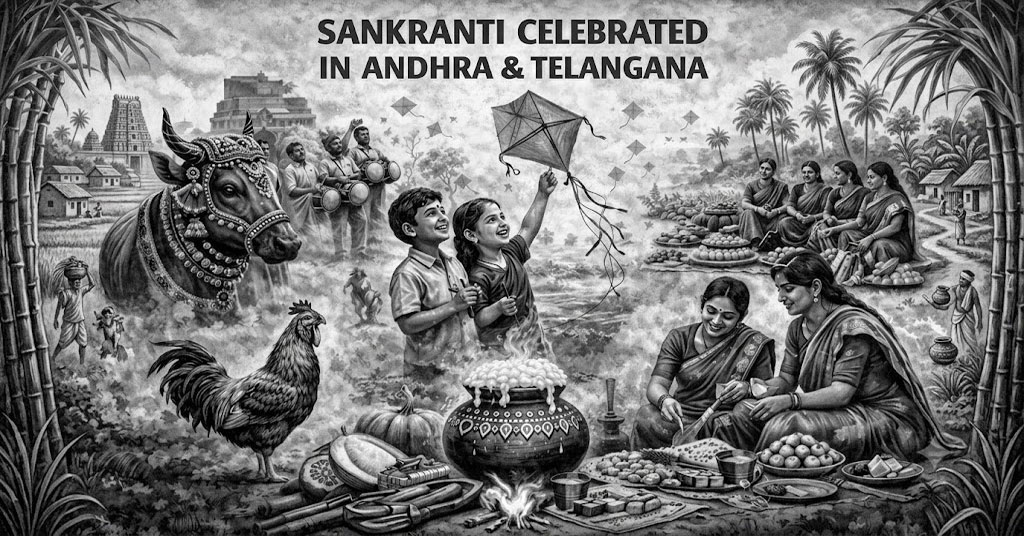
The first day of the festival is “Bhogi”, in the Telugu-speaking states of Andhra Pradesh and Telangana. On this day, the day starts even before dawn breaks out. As men are busy starting a bonfire in the village street with huge logs of wood, palm fronds, old furniture and sunbaked cow dung patties (bhogidandalu), women were busy with oil massaging and scrubbing every member of the family. Children would stand shivering in a row on the dark chilly winter morning, stripped to their underwear as they waited for their turn to be doused and massaged in coconut oil or sesame oil, followed by a vigorous scrubbing with a bright yellow thick paste which consisted of rice and green gram flour, turmeric, water and oil. It seemed like a struggle between the masseuse and the one being massaged, like a piece of furniture being polished zealously. The air was filled with squeals and groans of children, and groans and sighs from the adults. The skin now all warm, red and flushed, craves soothing cool water but, nothing prepares you for the sharp stinging of the steaming hot water (brought from the pots near the bonfire). ‘Pongal’-a porridge made with rice from the fresh harvest, dry-roasted split green gram or cowpeas, coconut, milk and jaggery, was the delicacy cooked on this day. Everyone sat cross-legged on the floor in a row, and each received a portion of a banana leaf for a plate. The steaming hot porridge was served at the center of the leaf. The cattle, the bullock carts, and the ploughs were bathed and washed and honored, as they formed an integral part of the agrarian culture.
Celebrating Togetherness
No human being can survive alone; we are a tribe, a community, a society and cannot do without the help of others. Sankranti serves as an epitome of togetherness and sharing. From cooking elaborate dishes to cockfights, all are community events. Making rice-based sweetmeats was one of the events of Sankranti – an extremely mesmerizing event to watch. It starts with the soaking of the rice for hours, which is later pounded into a damp flour, in the pounding stone. Ours was placed behind the house, in the backyard under the shade of a tamarind tree. My grandmother’s pounding stone was quite famous, and most of the villagers used it. Usually, two or three women or young girls would pound the rice with long wooden sticks, with their colorful sarees or skirts gathered and tucked at their waist. Gracefully poised over the stone with their wooden rods in their glass bangle adorned hands, each pounded one after the other meticulously without ever clashing. To keep the tempo going they often sang some ballads, with catchy tunes. They sounded very ancient and spoke of tales and woes of women. Next what followed was the cooking of the traditional rice sweetmeats – ‘ariselu’, ‘pongadalus’ and ‘pokundalu, later came the distribution of the sweets among friends and neighbours. If cooking and decorating homes were events at home, bullock-cart races, cockfights, jallikatu (bull taming) and kite flying were a part of this annual village events. A bustling crowd awaited at these events, with gambling fever at its peak in, especially betting on the most fierce and strong looking bulls or cocks.
Honoring Ancestors
Although the narrative around Sankranti talks about Hindu mythological gods, surprisingly none of the households in either of my grandparent’s villages had any images or idols of any deities. Nor were there any pictures of their ancestors. What was the reason? Poverty or lack of access to things such as photo studios stemming from caste discrimination and untouchability, or maybe both. So, on the wall in a corner of the house, smeared with turmeric paste and dotted with bright red vermillion, served as the site at which offerings of food and clothes were placed for the ancestors. These offerings were later donated to the poor, who were invited for this very reason. Such a similar custom of honoring the ancestors is prevalent in other Asian and South-East Asian countries as well, like Korea, China, Japan, Vietnam and Thailand.
Their harvest festival is celebrated in mid-autumn which is marked by ancestral rites, visiting graves and offerings of rice snacks. The custom of offering food to their ancestors was a regular affair at home. I remember my grandmothers and my mother would keep aside the first batch of any delicacies or special dishes they prepared, and we were not allowed to touch them for a while as they were for our ancestors. This batch was usually given away to a poor neighbour or a beggar.
Migration and Family Reunion
This is the season of migration. Some people start early and some just in time for the festival, but they all migrate- from abroad to homeland, large metros and cities or hometowns or villages. It’s the season of family reunion, getting together and connecting with family and friends. Booking tickets is often a nightmare in this month, either they are all full or priced very high. Yet travel is mandatory for most, and most cities seem empty and ghostly in this season. Interestingly a similar three-day harvest festival celebrated in Korea, Chuseok is also marked by migration and family reunion and is aptly called “National Migration”, where in the cities literally become deserted during this time.
Fading Cultures
The season of Sankranti heralds with the arrival of “Haridasu”, a quintessential feature of Sankranti. An indigenous community dressed in saffron robes, with garlands around their neck, bright brass or copper vessel balanced on their head, a ‘tambura’ (string instrument) in one hand and ‘chidatalu’ (small cymbals) in another, visited the villages every morning, at dawn, singing devotional verses. In the likeness of the Sage Narada, the mythological messenger of the gods, he often sings praise of the Lord Vishnu. Surprisingly they never begged, but just roamed the streets from dawn to dusk, only stopping for the voluntary offerings which they accepted not by hand but squatting down to accept them directly into the copper urn on their head. This tradition in fact echoes of a fading bhakti movement.
Yet another traditional folk performance during this season which seems to have been watered down from its past glory is the “Gangireddu”. It is one of the oldest folk arts of Andhra Pradesh, and an integral part of the agrarian culture. The main attraction of this performance by nomadic artists is a bull-strong, healthy and sharp horned. The bull is adorned with vibrant colorful saris, flowers, anklets and bells. Unlike “haridasu”, the man who led the bull, performed door to door. He often sported a long handlebar mustache and played the ‘nadaswaram’- a wind instrument. It is a sight to behold how he communicated with the bull through music and drums. Rice, clothes or money were offered in return for the blessings of prosperity and good health. The gangireddu visits started a month before Sankranti, peaking during the festival.
Nowadays it is a pathetic sight to see these gangireddu, for some starved animals are brought along with all its previous grandeur lost signaling a sharp decline. Another set of wandering minstrels of this season are the “Janagalu”. These performers are dressed in vivid colorful clothes, adorned with cowrie shells and feathers. They also performed door to door, singing folk lore of harvest, village life, ancestors, sun, thus connecting and highlighting the solar importance to Sankranti. This rural custom of oral folklore has been heading to its doom, as janagalu have become a rare sight in the last few decades.
Beyond Sankranti
When the bustle and buzz of the three-day festival is over, yet another series of events in the villages unfurl one after the other, like a domino effect. And these events were said to be more important than the actual festival itself to many. When my house-help always went home after the festival, it had me intrigued. As I enquired about it, with many from the local villages and my parents, their answer was the same. Following Sankranti almost every village had a festival and “jatara” (fair) honoring their local deities- and this deity was always a female – some “amma”. If it was a tree in some villages, it was a mere stone in others in a modest one roomed shelter which served as a temple. These events were vibrant, lively, and carnival-like. Could these be the lost traditions and festivals of our culture? Do we need to peel over the layers of these festivals to excavate our lost heritage.
Sankranti is predominantly a harvest festival than it is popularly known in the Indian Social consciousness as Hindu. Like most harvest festivals of India and the world, it shares the themes of abundance, renewal and thanksgiving. It revolves around rituals honoring nature, harvest, ancestors, bonfires, and sharing. Rice offerings are common in the Southern states and Assam, so as in the other Asian countries as well. Almost always these winter festivals celebrate the sun’s northward journey, which accounts for the astronomical element of the festival. No matter what the reason, the spirit of Sankranti encompasses family reunion, togetherness, sharing and a reset button to start yet another journey along with the sun to shine forth till the next winter arrives.
By Dr Sujatha Guttala