
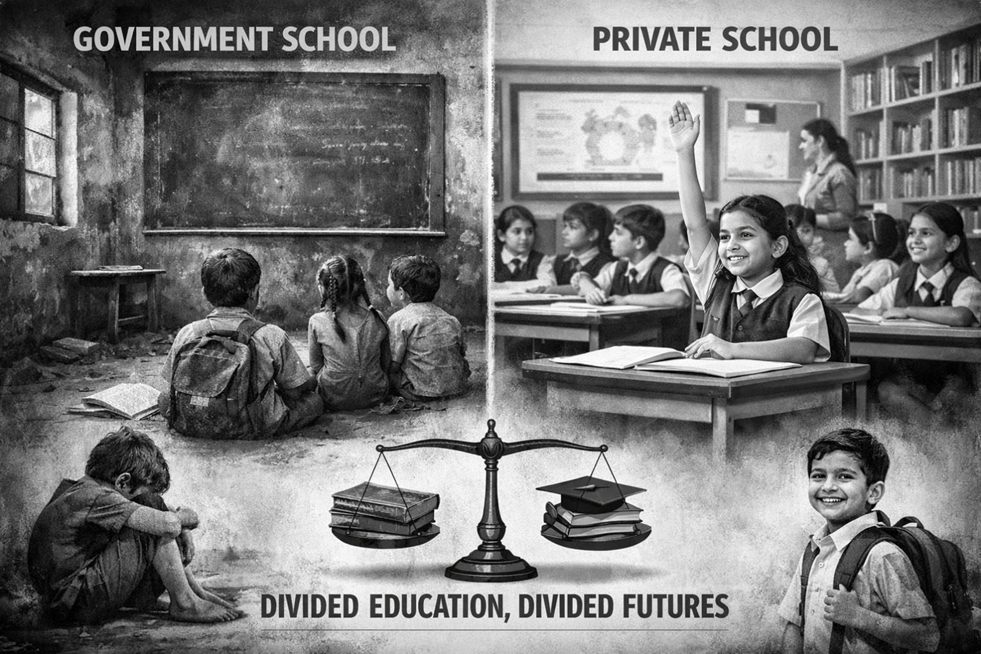
Today, education remains one of the starkest arenas of systemic inequality. Our children, the future of our country, are being subjected to enormous inequality in terms of quality of education being imparted in government schools. For most, education still remains the only means to progress and live a dignified human life. Inequality present in this ‘means’ of achieving dignified life leads to inequality of opportunity which ultimately leads to inequality in dignity of life. While we may include a few more elements that contribute to a dignified life, education remains the most significant of them all and no human dignity can be achieved without education. The global education development agenda reflected in the Goal 4 (SDG4) of the 2030 Agenda for Sustainable Development, adopted by India in 2015 – seeks to “ensure inclusive and equitable quality education and promote life-long learning opportunities for all” by 2030. This inequality exists in all the aspects of education such as access, quality, information, inclusion and opportunity. Commercialisation of education has led to two different worlds, with ever increasing disparity between the two. The government is not providing even the basic necessary amenities in schools, leave alone high quality, equitable education. The private schools that run primarily on profit motive, have occupied this space, claiming to fill the gap and making access to education purely dependent on money (financial capacity of parents of a child).
Factors Leading to Inequality in Education
In recent decades, private schools run on commercial lines have come to dominate a large space in school education. They claim to provide better quality than their government counterparts and attach a heavy price to it. This makes access to education directly dependent on the financial condition of a child’s family. While the claim of superior quality is not entirely true, private schools do create inequality in terms of infrastructure, exposure, amenities, awareness, and opportunities.
The rural–urban divide in education is glaring. In most states, government schools in rural areas lack even the most basic infrastructure, and the quality of education is almost non existent. Poverty cuts across rural and urban areas, though it is more visible in cities. Poor families have no option but to send their children to government schools, which suffer from inadequate infrastructure and low quality teaching. Given the near complete overlap of poverty and social backwardness in our country, children from socially and educationally backward communities are the worst sufferers of such inequality.
Gender bias continues even in today’s seemingly modern world. Families often pay more attention to the education of boys than girls. Many do not see girls as potential bread winners and therefore invest more in their sons. At school, girls are frequently discriminated against by teachers and staff. The majority of government schools in rural areas lack functional toilets, causing great inconvenience to girls and leading to dropouts. Other barriers, such as restrictions on travel or pursuing education outside their village or town, further deepen inequality.
Social backwardness in India is rooted in the unequal social order of varna and caste. Although the Constitution grants equal rights to education, children from marginalized castes still face barriers such as lack of awareness, discrimination in schools, and social labelling. Differences in home environment are another overlooked aspect of inequality: the number of rooms, study space, basic amenities, and family relationships all determine whether a child can study effectively at home, shaping learning outcomes.
The education and occupation of parents also play a crucial role. They determine whether children are sent to school and whether they receive support and motivation at home. The occupation of parents can significantly affect children’s education, sometimes cutting across financial conditions. Apart from these major factors, many other elements contribute to inequality in education, making it one of the most pressing challenges of our time.
What is Equal Education?
“Equal education” refers to the principle that every individual—regardless of background, socio‑economic status, religion, gender, region, or any other characteristic—should have access to the same quality of education. Its ultimate aim is to ensure that every child has an equal opportunity to reach their fullest human potential and contribute to nation‑building.
This goal can be achieved only when the barriers that lead to inequality are addressed. The solution lies in making high‑quality education equally available and independent of those factors. The question is not whether equal education is possible; the question is whether it is essential. We affirm that it is essential, for without it neither the dignity of the individual nor the unity and integrity of our nation can be secured. We also believe that equality in education is achievable—through the combined efforts of the people and the government.
How can Equality in Education be achieved?
There is no gain in blaming governments, cursing politicians, or criticizing the past. The only meaningful step is to act — to do something that improves the situation. We have taken that step by starting the Equal Education Campaign. In this campaign, our members act as Equal Education Volunteers and play a role of a catalyst in the process of ensuring all the basic facilities and good quality education in government schools. This campaign is a people’s campaign for the rights of their children – right to equal good quality of education and opportunities for their children. The campaign generates public demand for good quality infrastructure and good quality education in all schools, and improves cooperation and coordination among various stakeholders in school education.
Through this campaign, we must first do our part: ensuring that every child goes to school. We must also work together with schools and governments to guarantee that equal, good‑quality education is imparted to all children. This campaign is not against governments, teachers, or administrators; it is against no one. It cannot be. Governments, teachers, administrators, students, parents, and society at large are all stakeholders in school education, and they must work together to achieve it. Our Equal Education Volunteers are here to facilitate this process. Under the Right to Education Act, Sarva Shiksha Abhiyan, Madhyamik Shiksha Abhiyan, and now Samagra Shiksha Abhiyan, it has been promised that every school will have good facilities and quality education. Let us do our part: demand and ensure what is the right of every child.
In the schools in our neighborhoods, let us ensure the following:
• All children go to school
• Classrooms have lights and fans
• Desks, benches, or decent mats to sit on, and proper boards to teach
• Separate functional toilets for girls and boys, with running water
• Safe drinking water in school
• A library and sufficient teaching‑learning material
• Enough classrooms for all students
• Adequate numbers of trained teachers
• Regular teaching with appropriate pedagogy
• Good learning outcomes
• Information, opportunity, and career guidance
• Playgrounds, sports, games, and recreation facilities
• Effective value education that nurtures children into better human beings and citizens
• All other essentials for good‑quality education
(Note: This is not an exhaustive list; it highlights some important priorities.)
Our Role in the Campaign:
1. Meet teachers, parents, and socially aware people in the neighborhood to sensitize them about children’s right to equal, good‑quality education.
2. Facilitate the identification of gaps and preparation of a School Development Plan.
3. Follow up and ensure implementation of the plan at community, school, district, and state levels.
4. Track progress, document achievements and improvements, and share with stakeholders using dedicated tools.
5. Engage mainstream print and electronic media to highlight the necessity of the campaign and report its progress.
6. Use social media to sensitize society at large about the need for equal, good‑quality education for every child.
7. Organize peaceable assemblies, press conferences, media briefings, and meetings of Equal Education Teams for successful implementation.
Expected Outcomes:
1. Significant improvement in infrastructure and facilities in selected schools.
2. Significant improvement in teaching‑learning processes and outcomes.
3. Inculcation of humanistic values in children, reflected in visible behavior change.
4. Availability of high‑quality content on curriculum, career guidance, and libraries.
5. Every child receives equal, good‑quality education and the opportunity to grow to their fullest human potential.